
Making the Call: Large vs. Small Online Trainings
Topic
 Online Facilitation Tools
Language
Type
In intense political moments, it’s common to feel the pressure to gather as many people as possible, as quickly as possible. Large trainings are sometimes strategic for our goals, but larger isn’t always better. Our objectives, our capacity, and our understanding of our target participants help us decide what format will best help us reach our goals.
When designing online trainings, we start with the impact we hope to have. What do we want people to do after the training (our “organizing ask”)? What impact should our training have so people engage how we ask them to after the training? Our impact goals often include knowledge, skills, and attitudes/feelings we hope to develop or shift in participants during the training. For example:
- Knowledge impact goal: Participants know the basics (when, where, why) of our next action.
- Skills impact goal: Participants know how to respond to counterprotestors.
- Attitudes/feelings impact goal: Participants are motivated to show up at the action on Saturday.
Now that we’re clear on our impact goals, before we go any further, we ask ourselves: is a large or small online training the best strategy? (Note: When we say “large” we mean a training that is big enough we can’t track each person’s learning. That generally means 50 to thousands of participants.)
Here are some principles for when going large makes the most sense:
- At minimum, you must have the capacity to do a successful online training. (For example, if one person would have to lead it alone, it will be very challenging to have a strong impact with thousands of people.)
- When you have very little time to prepare for an action and need to mobilize a lot of people
- When it’s easy to tell that people gained the skill/outcome you’re looking for
- When it’s helpful to build energy with a large group of people
- When your budget simply won’t allow for many trainings and the impact you can have with a large group still feels worth it
Does a large online training format make sense for the impact you want to have with your online training? For more on creating impactful large online trainings, see Facilitation and Roles Prep for a Large Online Training.
Here’s a flowchart we created to help decide whether going large is strategic or not (text version below).
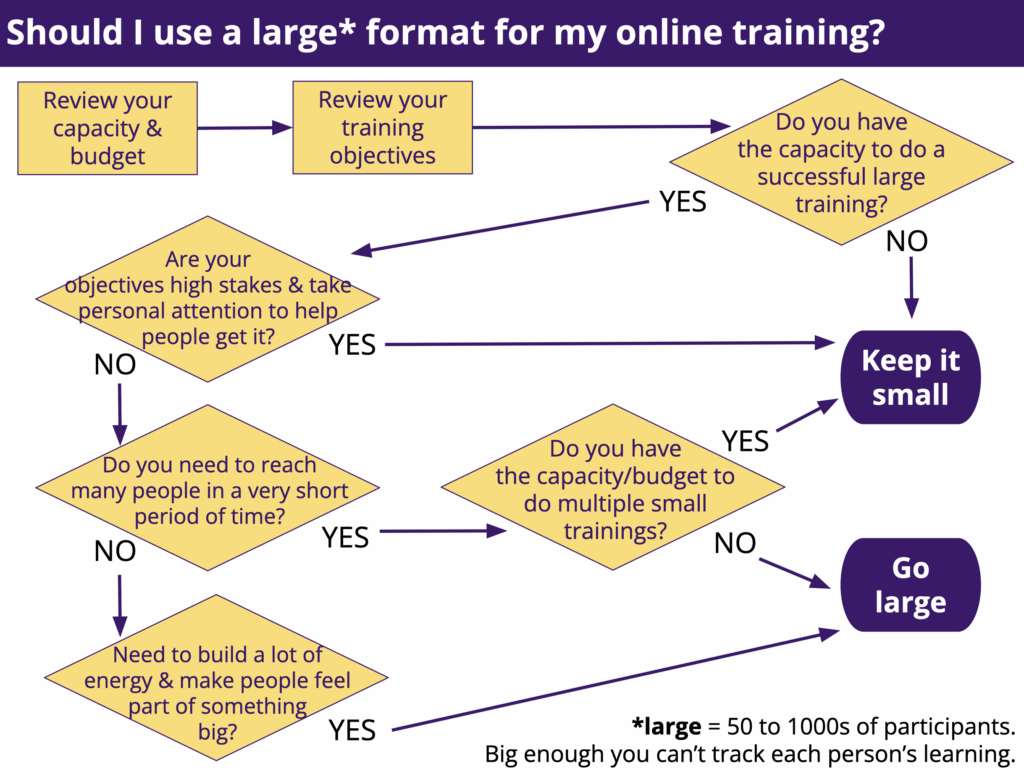
TEXT VERSION OF FLOWCHART:
*large = 50 to 1000s of participants. Big enough you can’t track each person’s learning
- First Review your capacity & budget.
- Then Review your training objectives.
- Ask: Do you have the capacity to do a successful large training? If no, then keep it small. If yes, continue to:
- Ask: Are your objectives high stakes & take personal attention to help people get it? If yes, then keep it small. If no, then continue to:
- Ask: Do you need to reach many people in a very short period of time? If no, then continue on to the next step. If yes, ask: Do you have the capacity/budget to do multiple small trainings? If yes, keep it small. If no, continue on to the next step.
- Ask: Do you need to build a lot of energy & make people feel part of something big? If yes, go large. If no, then keep it small.